What actually fails on a printed accessory
There are four failure modes, and most printed constructions lose to at least two of them.
Abrasion. A dampener sits against strings and gets handled every rally; a phone strap is in a pocket, a hand and a bag all day. Surface ink abrades; relief does not.
Sweat, sunscreen and sanitiser. Skin chemistry attacks printing ink from the outside while the part is being touched constantly. The mark goes first precisely where the brand wants it seen.
Flex and stretch. A bead chain stretches and a charm flexes with every pull. Rigid surface print cracks along the stress lines and starts to flake.
Colour drift. Even Pantone-matched print shifts from batch to batch as the ink film thickness varies. The brand colour is never quite locked.
None of these are fixed by choosing a better printer. They are fixed by changing what the mark is made of.
What moulded silicone does instead
A moulded part is not a printed surface — it is silicone with pigment mixed through the whole batch, formed in a steel mould. Logo, colour and charm shape are part of the material itself, so there is no ink layer to wear through: take off the top 0.2 mm and the colour is still there, because it runs the whole way through.
- Colour through the part. Pigment is compounded into the silicone, so the brand colour stays consistent across every unit and every reorder.
- Soft and skin-safe. 100% food-grade platinum-cured silicone, BPA-free, comfortable against skin and safe for items handled all day.
- Flex without cracking. The part stretches and returns, so straps and charms survive daily pull and twist.
- Pantone matched and stable. Colours are locked at the compound stage, not applied as a film.
Specification we build to:
| Property | Value |
|---|---|
| Material | 100% food-grade platinum-cured silicone, BPA-free |
| Temperature | −40 °C to 230 °C, no deformation or cracking |
| Colour | Solid or multi-colour, Pantone matched at the compound stage |
| Detail | 3D relief and custom shapes at ±0.01 mm mould accuracy |
| Finish | Matte, gloss or embossed, single or two-tone |
| Minimum order | 100 pieces per design |
| Sampling | 5–7 days |
| Production | 12–30 days |
Two lines we make this way
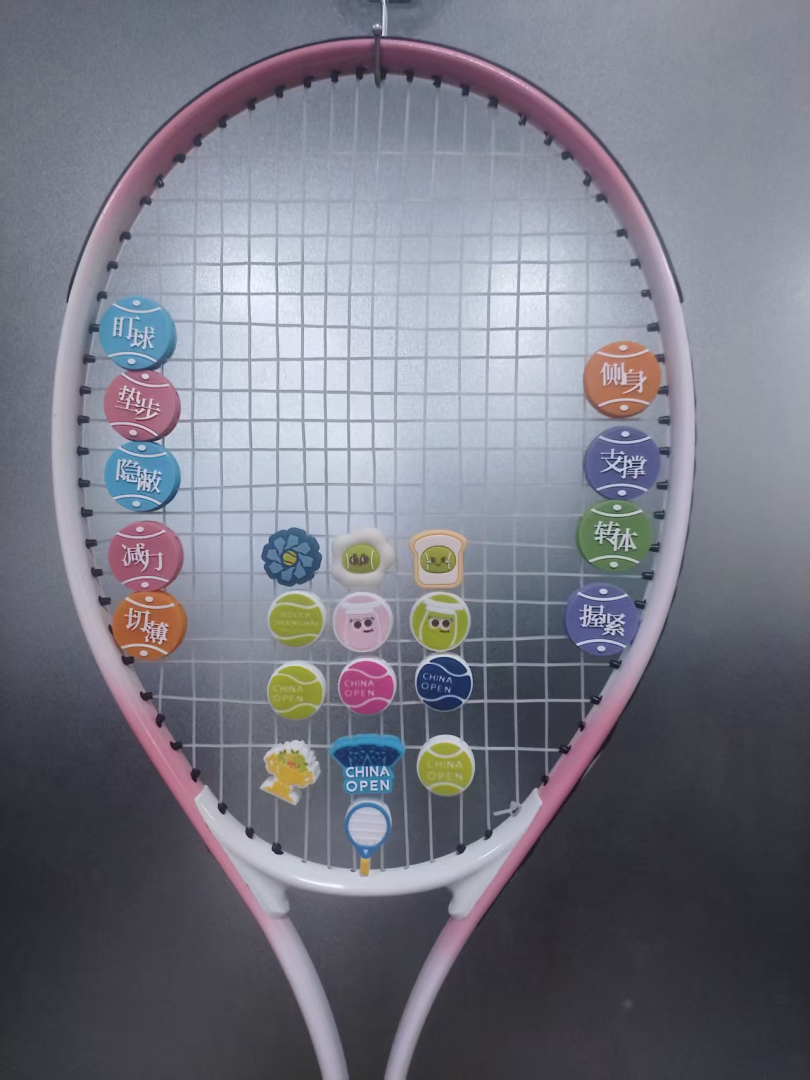
Tennis racket shock absorbers. Small moulded pads that sit at the base of the strings to dampen vibration and clean up the feel of every shot. We tool the shape, size and colour to your artwork, with a logo or mascot moulded into the face — no print to rub away during play.
Silicone bead chains. Phone straps and bag charms built from moulded silicone beads mixed with custom charms. Colours are matched to the brand, beads are strung and finished in our own facility, and the whole strand is soft, washable and safe to handle.
How it is made
- CNC mould making. The mould is cut at ±0.01 mm so edges stay sharp and custom shapes survive to the finished part.
- Compound refining. Pigmented silicone is milled to strip bubbles and lock an even colour.
- Compression moulding. Pre-weighed silicone cures in the cavity under heat and pressure for uniform density.
- Bead stringing and finishing. Beads and charms are assembled, checked and packed in the same facility.
Tooling is a one-off charge. The mould is dedicated to your design and repeat orders are not re-charged.
FAQ
Can you match our Pantone colours?
Yes. Colour is compounded into the silicone, so it stays consistent across the whole order and on reorders.
Will the logo rub off?
No. The mark is moulded into the part, not printed on the surface, so there is no layer to wear through.
Is it safe to handle all day?
Yes. We use 100% food-grade platinum-cured silicone, BPA-free, suitable for items held in the hand.
Minimum order and lead time?
100 pieces per design, sampling 5–7 days, production 12–30 days. Free 3D modelling before any steel is cut.